

Brand file
Is Liquid Death just water? What is actually in the can
The skull is marketing. The water inside has a lab report, and it changed when the source moved from Austria to Virginia.
By the Waterphile team · · 4 min read
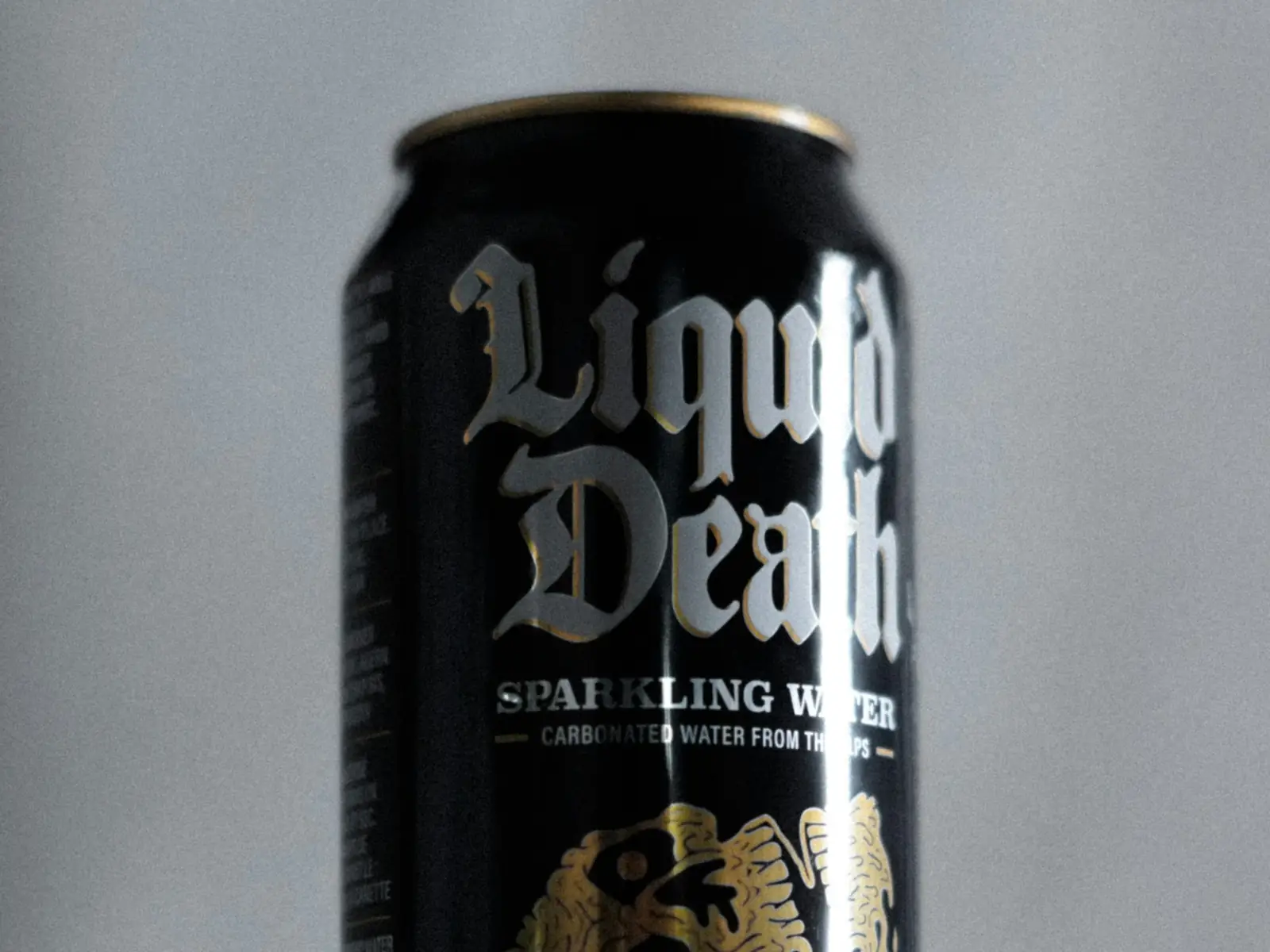
Yes. Liquid Death's still Mountain Water is water, and nothing else is added to it. The more interesting questions are which water, from where, and whether it is the same water people were drinking a few years ago. The brand's own lab reports answer all three.
Where the water comes from
Liquid Death's water quality page lists a single source for its water: the Blue Ridge Mountains, in Bland, Virginia.[1] The report linked from that page is a lab analysis of the finished still product, and it names the source as the "3300 Artesian Well" in Bland.[2]
"Artesian" is a legal term in the US, not a mood. Under FDA rules, artesian water comes from a well that taps a confined aquifer, an underground layer of water held under pressure, where the water level stands above the top of the aquifer. A bottler may use a pump to help it along, but must be able to show regulators that the water level meets that test.[3]
It is also worth knowing what the FDA means by bottled water in the first place: water sealed in a container "with no added ingredients", apart from optional safe antimicrobial agents and, within limits, fluoride.[3] So the honest answer to "is it just water?" is that it is legally required to be.
The flavoured sparkling drinks and iced teas Liquid Death also sells are different products.[4] This post is only about the still Mountain Water.
What the lab report says
Here is the still water next to a few well-known waters on Waterphile. All values come from each brand's own published report or site.
| Water | pH | TDS mg/L | Calcium mg/L | Magnesium mg/L | Sodium mg/L | Sulfate mg/L | Score |
|---|---|---|---|---|---|---|---|
| Liquid Death Mountain Water (Still) | 7.8 | 120 | 30 | 5.7 | 2.8 | 9.7 | 8.7 |
| Evian | 7.2 | 345 | 80 | 26 | 6.5 | 14 | 9.8 |
| FIJI Water | 7.91 | 210 | 18 | 14 | 17 | 0.5 | 9.3 |
| Essentia | 9.92 | 61.33 | ND | 1.42 | 15 | 3.17 | 7.3 |
Liquid Death sits in the middle. With total dissolved solids of 120 mg/L, it carries roughly a third of Evian's mineral load and a bit over half of FIJI's, but about twice Essentia's (our calculation from the published values; Evian publishes dry residue, a close cousin of TDS). Calcium, at 30 mg/L, is the main mineral. Magnesium is 5.7 mg/L and sodium is very low at 2.8 mg/L.
That sodium figure is well under the 20 mg/L that European rules require before a natural mineral water can be labelled "suitable for a low-sodium diet".[5] Liquid Death is a US artesian water, not an EU mineral water, so the label rule does not apply to it. It is just a useful yardstick. For scale, the FDA Daily Value for sodium is less than 2,300 mg a day, so a full litre of Liquid Death supplies about 0.1% of that (our calculation).[6]
The pH is 7.8, slightly above neutral. Nitrate is listed as 0.16 mg/L as N, far below the FDA limit of 10 mg/L as nitrogen.[3]
One thing is missing. The report prints bicarbonate as 91, the same number as alkalinity, without saying which unit it is in. Since the two units differ, we leave bicarbonate empty rather than guess. That is the only one of the nine properties the Waterphile Score uses that we could not fill in. Liquid Death scores 8.7 out of 10, 69th of 231 scored waters. See how scores work.
Yes, the water changed
Liquid Death did not start in Virginia. Its earlier report, still online, says the water came from "a private protected underground source managed by Starzinger in Frankenmarkt, Austria", processed with filtration and pasteurisation.[7] In the summer of 2024 the company said it had completed a move from European production to 100% US manufacturing.[4] In February 2025 it paused sales outside the US, telling The Grocer that it no longer had production capabilities outside the country.[8]
Drinkers noticed the change before the press did. In April 2023 a Reddit post in r/HydroHomies titled "Liquid Death is no longer water from the alps" described the new cans saying "natural artesian water" with Virginia as the source, and the poster said the water tasted different. Some replies said they had noticed the same.[9] A 2024 thread on smaller cans labelled "still drinking water" asked whether that meant tap water; the most upvoted answer pointed out that "still" only means not carbonated.[10] Those are individual impressions, not tests. The lab reports, though, show that the composition really did change:
| Austria (2020 sample, Well #3) | Virginia (2026 report) | |
|---|---|---|
| pH | 8.0 | 7.8 |
| Total dissolved solids | 170 mg/L | 120 mg/L |
| Calcium | 27 mg/L | 30 mg/L |
| Magnesium | 16 mg/L | 5.7 mg/L |
| Sodium | 12 mg/L | 2.8 mg/L |
| Sulfate | 7.5 mg/L | 9.7 mg/L |
Austrian figures from the earlier report[7]; Virginia figures from the current one.[2]
The Virginia water has less of almost everything. Magnesium dropped to about a third of the old level and sodium to under a quarter, while calcium stayed roughly the same (our calculation). A lab sheet cannot prove what the Reddit posters were tasting. It does show that "it tastes different" had a basis: it is a different water.
If you still have an old can bought in the UK or Europe, it most likely came from the Austrian plant.[8] The brand's reports page now lists only the Bland, Virginia source.[1]
So is it worth it?
That depends on what you are paying for. On the numbers alone, Liquid Death's still water is a light, low-sodium water with modest calcium. It scores well because its pH, sodium, sulfate, chloride and nitrate all sit inside the ranges the Waterphile Score treats as ideal. Its total minerals, calcium and magnesium are below those ranges, which the score marks down only gently. Beyond the water, you are paying for an aluminium can and a brand.
If you want to see how it stacks up against a specific water, the compare tool puts any two side by side. Two good starting points: Liquid Death vs Essentia, a natural artesian water against a purified, ionised one, and Liquid Death vs Evian, a light water against a mineral-rich one. The full lab values are on the Liquid Death page.
Sources
- 1Liquid Death, Water Quality Reports page (source listed: Blue Ridge Mountains, Bland, Virginia)
- 2Liquid Death Still, finished product report, 3300 Artesian Well, Bland, Virginia (Compliance Designs report 1265-342, Q1 2026)
- 3US FDA, 21 CFR §165.110 Bottled water (identity and quality standards)
- 4FoodBev Media, Liquid Death temporarily halts UK operations (company statement), Feb 2025
- 5Directive 2009/54/EC on natural mineral waters, Annex III (labelling criteria)
- 6US FDA, Daily Value on the Nutrition and Supplement Facts Labels
- 7Liquid Death Bottled Water Report (California SB 220), former source Starzinger, Frankenmarkt, Austria; lab sample of 2020
- 8The Grocer, Liquid Death to exit UK after sales fail to make a splash, 6 Feb 2025
- 9Reddit r/HydroHomies, Liquid Death is no longer water from the alps (April 2023)
- 10Reddit r/HydroHomies, Liquid death - still drinking water (July 2024)
Brand values come from each brand's own report or site, linked on its Waterphile page. Percentages and comparisons marked as our calculation are arithmetic on those published values.
NextS.Pellegrino vs Perrier vs Topo Chico: the minerals behind the bubbles
Not medical advice. Waterphile shows mineral values as published by each brand, for general information only. If you have a health condition, follow a restricted diet or prepare infant formula, ask a doctor, pediatrician or health visitor.